The Multi-Country Office for Jamaica, The Bahamas, Bermuda, The Cayman Islands and Turks and Caicos Islands, is located in Jamaica and works under the leadership of one United Nations Resident Coordinator, together with UN teams and partners, to advance sustainable development and cooperation in the Caribbean.
The UN Country Team (UNCT) in Jamaica carries out its brand promise of Delivering Results Together through a joint framework called the UN Multi Country Sustainable Development Framework (UN MSDF) in the Caribbean. The UN System in Jamaica will implement the UN MSDF for the Caribbean guided by a Country Implementation Plan (CIP) for Jamaica. The CIP operationalizes the higher level outcomes of the regional programme into concrete, measurable and time bound outputs and activities for Jamaica. CIPs running for one year periods are developed throughout the five-year life of the programme, starting in 2017 and ending 2021, setting out Jamaica’s year to year action on the UN MSDF.
The UNCT works in collaboration with the Government of Jamaica to implement the strategy, monitor impact and to ensure adequate resource allocation for programme delivery. Implementation and oversight of Jamaica’s CIP is coordinated by a Joint National/United Nations Steering Committee (JNCS) established under the leadership of the Government of Jamaica and the UN Resident Coordinator.
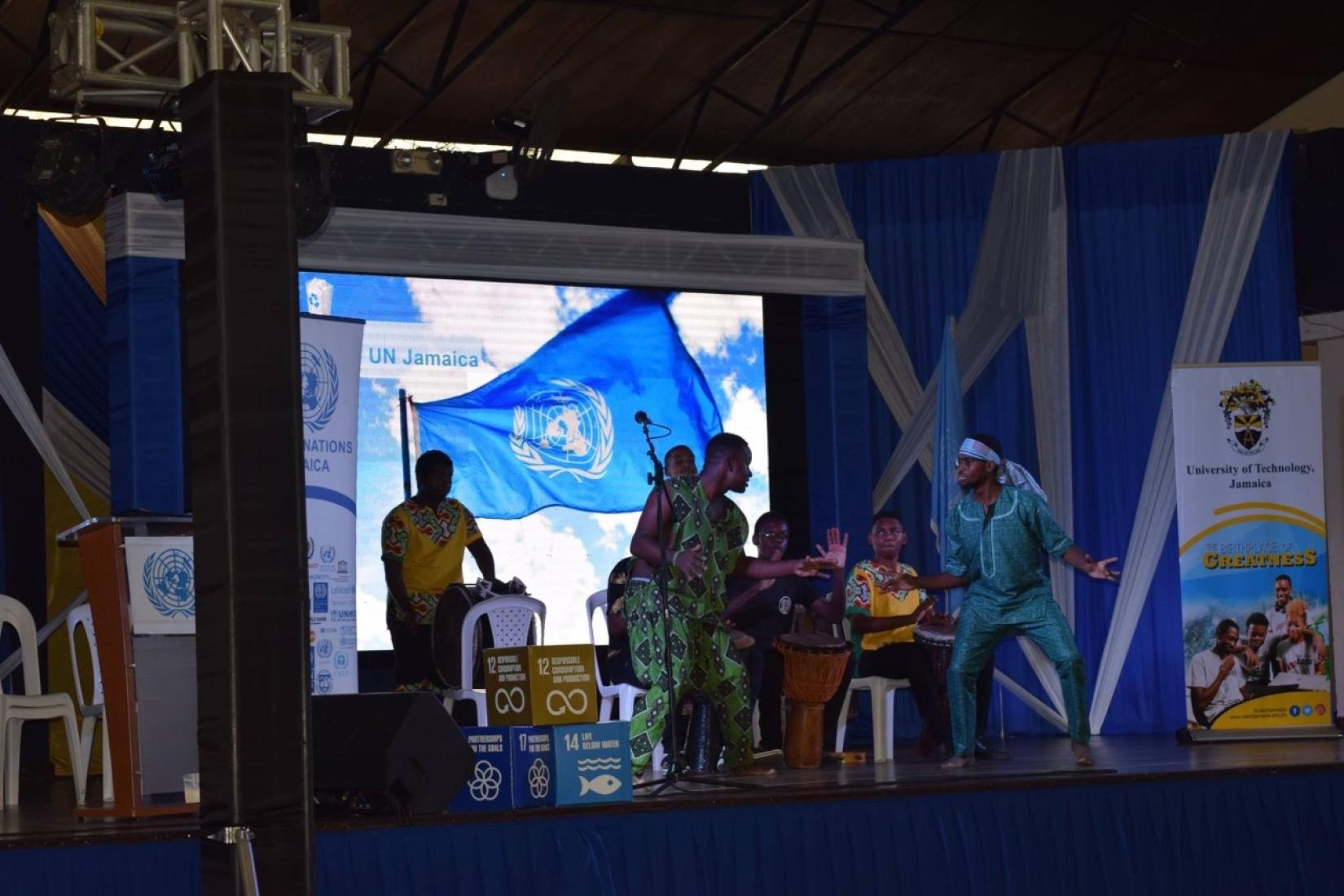
Caption: Young people participate in UN Day activities, a signature annual event of Jamaica’s UN country team commemorating the creation of the UN Charter in 1945.
Jamaica continues to integrate human rights approaches across the fabric of its security and justice systems. Human rights observatory established and in use to record human rights violations.
2
Jamaica has adopted the 2030 Agenda for Sustainable Development, along with the SDGs. These are well aligned with Jamaica’s National Development Plan, ‘Vision 2030.’
3
Jamaica has ratified the Paris Agreement and is able to report its climate change obligations to the UNFCCC. Increasing number of rural communities, schools, public sector institutions are advancing climate change adaptation and mitigation and disaster risk reduction through climate-resilient technologies and innovations.
4
The country continues to improve access to quality education and lifelong learning and access to equitable social protection systems.
5
Kingston selected as a Fast-Track city for the acceleration of local AIDS response towards achieving the UNAIDS 90-90-90. National Health Research Agenda, the National Rollout of Standards for Adolescent Health Services and nationwide healthy lifestyles campaign is advancing Universal Access to quality health care.
6
National commitment to UN reform processes including the provision of a common premises at UN House.
1 / 6
The Sustainable Development Goals in Jamaica
The Sustainable Development Goals are a global call to action to end poverty, protect the earth’s environment and climate, and ensure that people everywhere can enjoy peace and prosperity.
Kindly note that the data visualizations show an aggregate of the Caribbean. To view the disaggregated data per country, please click on the name of the country or territory you wish to explore.
Help us improve your experience.
We are upgrading this website platform to make it clearer,
faster and more accessible.
Can you take a two-minute survey to share your feedback and help shape this upgrade?