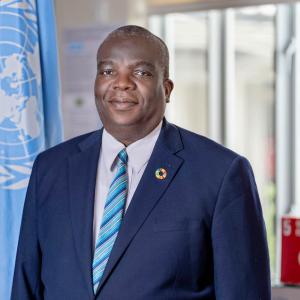
Remarks Mr. Dennis Zulu, United Nations Resident Coordinator Regional Ocean Conservation Youth Workshop 2026
Good morning.
Let me begin with a confession. I have sat through many opening ceremonies, and I have given many speeches. Most of them are forgotten by lunch. So this morning I am not going to give you a ceremony. I am going to give you an argument.
You come from twenty-one countries and territories. Some of you crossed the Caribbean Sea to be here. And I want you to hold on to that for a moment, because the water you crossed is not the backdrop to this workshop. It is the subject of it. It is also, for the people of this region, the economy, the food supply, the storm barrier, the culture and the memory. When we in the UN talk about Sustainable Development Goal 14, life below water, we are not talking about something out there. In the Caribbean, life below water is life. Full stop.
And here is the part of the argument that too many people miss. Goal 14 and Goal 15 are not neighbours. They are one system. Life on land and life below water are joined at the coast, and the coast is exactly where this region lives. Cut down a hillside forest and the soil runs into the sea and smothers the reef. Lose the reef and the fish nurseries collapse. Lose the fish and a family in Old Harbour Bay or Portland Cottage loses its income, its protein and its way of life. Nothing in that chain is abstract. Every link in it is a person.
Jamaica learned this the hard way, and recently. When Hurricane Melissa struck this country, the communities that suffered most were coastal communities. But we also saw something else. Where mangroves still stood, they did what mangroves have always done. They broke the force of the water. They held the land together. A healthy mangrove forest is not scenery. It is infrastructure. It is a seawall that plants itself, repairs itself, feeds the fishery and buries carbon while it works, which is why blue carbon is on your agenda this week.
That is why the United Nations and its partners are investing in restoration in this region. Mangrove replanting is under way here in Jamaica. Coral restoration work is putting fragments of living reef back onto degraded beds, patch by patch, hand by hand. I will be honest with you. This work is slow. It is unglamorous. A coral fragment does not care about a press release. It grows at its own pace or it dies. But it is some of the most important work happening anywhere in this region, because it is the work of giving the sea back its ability to protect us.
Here in Kingston, The UNEP Caribbean Environment Programme, as many of you know, provides the programmatic framework for the Cartagena Convention, the only regional agreement of its kind allowing governments to work together to protect the region
through improved management of coastal and marine resources, and more than 300 species of marine and coastal flora and fauna are now protected under its SPAW Protocol, with all parrotfishes and the Caribbean reef shark added in 2023. The GEF-funded PROCARIBE+ project (2023 to 2027) is helping to protect and restore the ocean's natural capital and supporting the establishment and strengthening of marine protected areas across the Wider Caribbean, among other projects. Significant work is being undertaken, but you know more than most the vastness of the current needs.
Now, the harder truth. Restoration alone will not save the Caribbean Sea. Not while the water keeps warming and bleaching the reefs. Not while sargassum keeps rolling onto beaches in quantities your grandparents never saw. Not while plastic arrives on every tide. Not while decisions about deep seabed mining, about marine protected areas, about ocean governance, are made in rooms where this region's voice is too quiet and too few of the people in the room will ever live with the consequences.
We all have a job to do.
I did not come here to tell you that you are the leaders of tomorrow. You have heard that speech. I do not believe it, and frankly, neither do you. The evidence says otherwise. It was young people who forced loss and damage onto the world's agenda. It was small island states, this region among them, that fought for the 1.5 degree limit when larger powers called it unrealistic. The pattern is clear. When this region speaks with one clear voice, the world adjusts. You are not waiting for a turn, for a tomorrow that is always in waiting. The turn is now, and it has your name on it.
So here is what I am asking of you this week, leave as energized advocates. Take what you learn about blue carbon, about mangroves, about coral, about governance, and carry it into rooms where it is missing. Into your ministries. Into your school and universities. Into fisherfolk associations and town councils. Into the negotiations on plastics and the high seas. Advocacy is not noise. Advocacy is knowledge, aimed.
And hear me clearly on this. You do not walk into those rooms alone. The United Nations system in this region stands behind you. The Sustainable Development Goals are not our goals to guard. They are yours to claim, and to hold us accountable to, all of us, governments, agencies, and yes, the UN itself. Hold our feet to the fire. That is not a threat to the system. That is the system working.
The sea has fed this region, carried it, shaped its music and its language and with every passing hurricane season, more grief. Our waters have kept its side of the bargain for centuries. This is the generation that decides whether we keep ours.
Let’s get to work, hand in hand.
Thank you.


Speech by
Goals we are supporting through this initiative